Gwynplaine’s speech in the House of Lords is mocked
The Man Who LaughsGwynplaine’s speech in the House of Lords is a failed attempt to convert aristocratic recognition into a hearing for the poor. Newly admitted as Lord Fermain Clancharlie, he speaks from personal experience of deprivation and argues that privilege rests on the suffering of others. But his fixed, involuntary grin makes the assembly treat his testimony as a performance. The contrast between the applause that once greeted him in the Green Box and the laughter that now silences him turns his elevation into catastrophe.
Admission and the burden of appearance
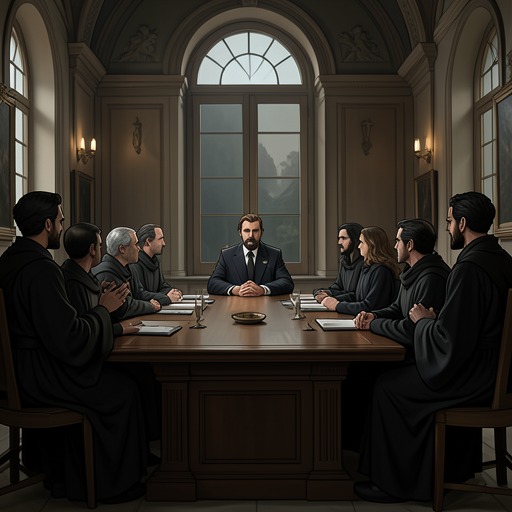
The event begins when the clerk, after checking the register, announces Gwynplaine by his newly recognized title, Lord Fermain Clancharlie, Baron Clancharlie and Hunkerville. Gwynplaine rises and registers his dissent. His formal entrance into the House gives him a place among the peers, but it does not free him from the face by which the public has long identified him. The clerk’s announcement establishes the gap at the heart of the scene: the institution recognizes a lord, while the assembly continues to see the Laughing Man.
That gap has been built into Gwynplaine’s public life. His mouth, eyes, and other features have been altered into a permanent expression of laughter, while his body remains tall, well-made, and agile. The face is not an expression of his inner state: it persists when he is serious, distressed, or moved. As a mountebank, he has drawn crowds whose laughter makes him a popular success; his appearance has also made him difficult to look at once the novelty wears off. In the House of Lords, the same involuntary expression that helped fill the Green Box obstructs his effort to speak as a person rather than as an exhibit.
An appeal from below
Gwynplaine opens by presenting himself as a figure of wretchedness and announcing that he has a word for the peers. He acknowledges their height, wealth, pleasure, authority, and apparent distance from ordinary hardship, then insists that humanity exists below their station and must be brought to their attention. His argument is not based on abstract observation alone. He speaks as someone who has experienced poverty, cold, hunger, contempt, illness, and shame, and says that his former life among the poor gives him standing to describe what the powerful cannot see from their position.
He explains his presence in the chamber as a duty rather than a personal triumph. Although the summons and his sudden elevation might have suggested an escape from his former life, he says that his heart remains elsewhere and that his past among the destitute has brought him before those who have enough. He frames the address as testimony on behalf of a scattered multitude whose claims he cannot neatly arrange. The speech’s scale grows out of that tension: a newly titled man speaks for people excluded from the chamber, while acknowledging that his own authority to do so derives from having lived among them.
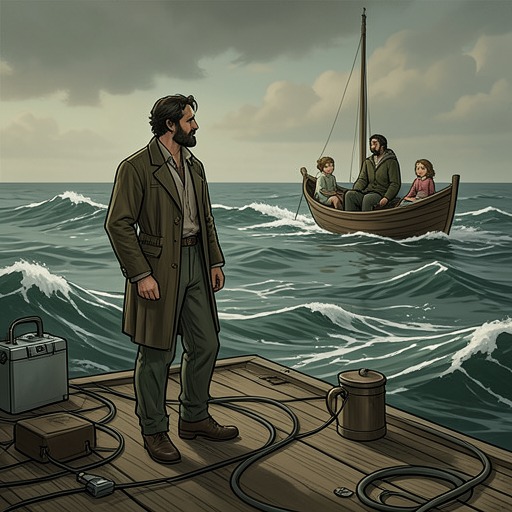
To make the distance between privilege and deprivation concrete, Gwynplaine recalls his first encounter with society as an abandoned child in a storm. In that recollection, the law appeared as a gibbet, wealth as a woman dead from cold and hunger, the future as a child left to die, and goodness, truth, and justice as a vagabond accompanied by a wolf. The images compress his childhood experience into an indictment of the social order: institutions and riches are visible, but they offer no protection to the abandoned. His speech thus joins a political claim to a personal history rather than treating poverty as a subject he has merely observed.
The fixed grin turns testimony into spectacle
Gwynplaine’s effort to speak against privilege depends on an appearance he cannot control. When emotion rises in his throat, he breaks into laughter. The response spreads through the chamber: the assembly moves from a moment of stillness to amusement, and the peers begin to address him as a clown and performer. Their remarks reduce his argument to the familiar role that audiences have assigned him outside Parliament. They praise the supposed performance, call attention to his face, and question whether someone like him can be a peer.
The episode repeats, in a harsher setting, the public mechanism that had made Gwynplaine famous. At the fairground, people laughed at the sight of him, even when their own moods were solemn; his face, rather than his thoughts, dictated their reaction. In the chamber, the consequence is more than a distraction from his words. The laughter reclaims control of the encounter for the audience and makes the speaker’s attempt at seriousness appear comic. The narrative stresses that his spoken appeal and his visible expression seem to point in opposite directions, leaving him exposed to the very interpretation he is trying to resist.
Social criticism and its reversal
Gwynplaine tries to regain the peers’ attention by warning that their power carries responsibility. He argues that the rich prosper through the impoverishment of the poor, criticizes laws and taxation that burden those below, and presents the welfare of the whole society as inseparable from that of its lowest members. He also attacks monarchy and recalls his family’s history: a king sold him, a prince mutilated him, and a poor man sheltered and nourished him. His title has admitted him into the ranks of the great, he insists, but it has not erased his connection to those who suffer.
The speech then makes his face its central political figure. Gwynplaine describes the grin as an imposed mark and interprets it as an image of humanity deformed by its masters: suffering concealed beneath an appearance of gaiety. In this account, he is not an exception whose unusual body invites curiosity, but a representative of a wider injury. He predicts that the people’s suppressed suffering will eventually break through the apparent stability of privilege, and invokes the Republic as an earlier rupture in the authority of kings. His public identity as Lord Clancharlie and his remembered identity as Gwynplaine become opposing sides of a single argument: aristocratic rank gives him access to the chamber, while his past gives him a reason to challenge it.
The peers’ laughter intensifies rather than subsides. The narrator presents their amusement as a form of punishment: the assembly turns its collective attention against the speaker, and its jokes make him the target of ridicule. Gwynplaine can no longer master either his face or the audience’s response. The scene reverses his earlier theatrical success, where a crowd’s laughter brought applause and recall; here, the same reflex makes his political speech fail and leaves him humiliated.
Adjournment and consequence
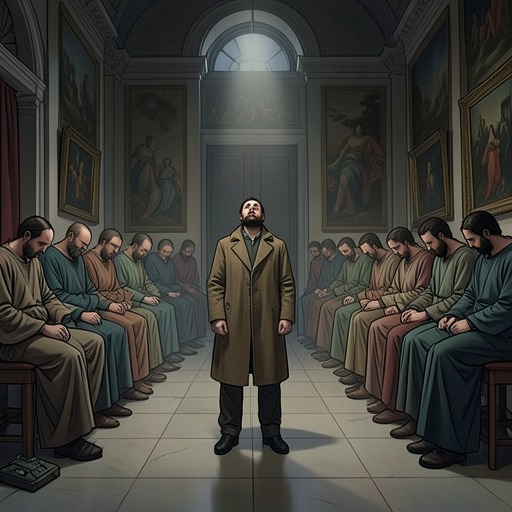
The Lord Chancellor adjourns the House until the following day because of extraordinary circumstances. The peers leave, and the chamber that had been full of voices returns to silence. The immediate institutional result is an interrupted sitting, not a persuasive victory for Gwynplaine. His address has made the conflict between privilege and poverty audible, but the assembly’s response prevents that appeal from becoming a sustained exchange.
The scene’s decisive reversal lies in the difference between possessing a title and being heard. Gwynplaine enters as a recognized peer and speaks with the authority of lived hardship, yet the room treats his permanent grin as permission to laugh at him. The Green Box had made that face an instrument of popular success; among the lords, it becomes the means by which they evade the seriousness of his words. His speech exposes how public identity can be imposed by an audience, even when the speaker is trying to define himself—and how the most powerful listeners can turn testimony into entertainment rather than answer its claims.